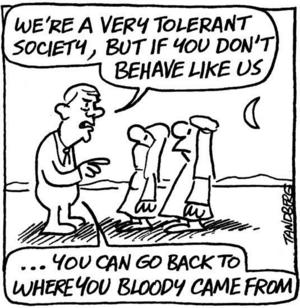
In my childhood, I could see a lot of discrimination, but at the time did not have sufficient knowledge about discrimination. In our areas, school and sports club that I went to in my childhood, there is rises in each group of young founders gang and all the other don't like gang, including problems at least reasons so they fight among each other and insult each other, so that the citizens of the country forming a gang among themselves, foreigners also have their own band, these problems present. Also, between the tribes themselves and between residents in the country and also there are problems concerning the assets of citizens in the State of naturalization and these things, there are most problems at the school where that person who did not like its look and does not view its abuse or are beaten, and there judge a person without knowledge that problems. Also I remember that there was a person of foreign nationality was a peaceful country is not between him and one of the Shi but color it gets indecent by some black skin, ugly and stupid, Well you fall into some problems when they do not share the error involved, there was no provision for people on nationality where every nationality has certain characteristics as swindlers or the thieves, such titles are not decent to say. These problems are present in adults and "Unfortunately children from their parents or relatives, but these days we don’t have these problems because of the awareness in our society there are also societal institutions. In addition, there should be more awareness about cultural diversity, especially with the increasing proportion of nationalities in the country and the different cultures and customs traditional between these nationalities may have some difficulty in handling them.
Monday, October 22, 2012
Personal Reflection #3 - Stereotyping & Bias
Portfolio Exercise #6 - Stereotyping & Blue Eyes Video
Goal 2 Adverse Reactions to
Diversity
– 2012 - Semester
Course: Cultural Diversity Code: LSS N2053
Name: Mohamad Haroun ID#
H00254387
With a partner, please answer the following. You may use
internet resources to help you.
1.
Define:
a.
Stereotyping: categorize
b.
Prejudice: favor
c.
Bias: alignment
d.
Discrimination: recognition
2.
Give an example of each term
a-
A stereotype is a
thought that may be adopted about specific
types of individuals or certain ways of doing things, but that belief may or
may not accurately reflect reality.
b-
A prejudice is most often used to refer to preconceived, usually
unfavorable, judgments toward people or a person because of gender, social
class, age, disability, religion, sexuality, race/ethnicity, language,
nationality or other personal characteristics.
c-
Bias is an inclination to present or hold
a partial perspective at the expense of (possibly equally valid) alternatives.
d- Discrimination is the prejudicial or
distinguishing treatment of an individual based on his or her membership - or
perceived membership - in a certain group or category.
Watch Class Divided
ü Understanding
With partners, answer the following:
1.
Where, when and with whom
did this experiment take place? Midwest USA, 1968, ellenoy.
2.
Describe
the experiment. It’s to teach them what to make fun of other people by their
outside look.
3.
What
were the results? Very successful.
4.
How
successful do you believe it was? The children start to think of other
people the same.
Going Deeper
In
groups of four, discuss the following:
Ø a time you experienced prejudice or discrimination
Ø a time you discriminated against somebody else
Ø a time you witnessed
discrimination and did nothing about
it
Ø a time you witnessed discrimination and did something about it
·
I don't like the local
people how discriminant about.
·
There is a common rule among people that the Egyptians
are swindlers and thieves.
·
There is sensitivity when some locals, about the
origins of some citizens.
·
Some people hate the person through its look was ugly
hated him and that its look was handsome
loved him.
Thursday, October 11, 2012
Diversity and Personal Conduct / vocabulary Portfolio #5
Find the definition OR synonym of each of the words:
1. Civility / civilized : Urban
2. Acknowledge: Grant
3. Inclusive / inclusion: Comprehensive
4. Respect: Esteem
5. Apology: Formal written defense of something you believe in strongly
6. Consideration: The process of giving careful thought to something Behavior
7. Responsibility: The proper sphere or extent of your activities; "it was his province to take care of himself"
8. Attention (pay): The process whereby a person concentrates on some features of the environment to the (relative) exclusion of others
9. Tolerance: The process whereby a person concentrates on some features of the environment to the (relative) exclusion of others.
10. Attitude (positive): A complex mental state involving beliefs and feelings and values and dispositions to act in certain ways; "he had the attitude that work was fun"
11. Conduct: Perform
12. Politeness : A courteous manner that respects accepted social usage
13. Constructive (comment): Formative
14. Kindness: The quality of being warmhearted and considerate and humane and sympathetic
Sunday, October 7, 2012
Who are the Americans?
Discuss and note your ideas
Who lives in America? Where did they come from? When?
Spain, came from Euro, in the 17th century
Have you seen any films about people emigrating to America? Which?
No I did not.
Were there any immigrants on The Titanic?
Yes there were immigrants on the titanic
Research
Look at this website and study the data, especially the ‘by region’ information to find out where Americans come from: http://teacher.scholastic.com/activities/immigration/immigration_data/
1. Explore the historical timeline to see where the immigrants arrived from in different eras. Choose one link from ‘A New Land’, ‘Expanding America’ and ‘A Place of Refuge’ menus and note: Where did the people come from and why did they go to America.
A New Land: They came from Europe,(Spain)(England)(France), most of them they immigrated because of freedom and food and resources.
Expanding America: They had large of immigrates, while the revolution war . In 19th century one million slaves from Africa where imported there and they were not citizen in early 19th century nearly all immigrates was from western Euro.
A Place of Refuge: World War 2 happened and the economy went down and it wasn’t the perfect land to go and the immigration percentage went down . some people thought of immigrating to some another country.
2. Look at the ‘Building a Modern America’ – ‘A Multicultural America’ page. What information can you find about recent US immigration?
A major change to immigration legislation in 1965 paved the way for new waves of immigration from all over of the world. Asians and Latin Americans arrived in large numbers, while European immigration declined.
3. Now click on ‘Explore Ellis Island’ and answer the questions. (There is 1 question per page.)
- Where did immigrants land when they arrived in America?
Ellis Island Immigration Station between 1892 and 1954.
- How long did it take to cross the Atlantic?
This trip across the Atlantic ocean lasted for one two weeks.
- What was the first thing people saw in America?
Statue of liberty
- What did the officers give the immigrants?
Paper with all the names
- What did the doctors do while the people walked upstairs?
Test the people for any illness
- Why couldn’t women enter America alone?
- What did the chalk marks X and P mean? What happened to those people?
- How many questions did they ask immigrants? Twenty nine questions
- When did pre-departure health checks start?
- What facilities were available at the bottom of the stairs?
What happened at ‘The Kissing Post’?
It got this nickname because its where family and friends waited their loved ones.
Think!
When people come to work in the UAE, what must they do? (Paperwork, procedures, tests…)
America is a multicultural society; it is culturally diverse. It is not a ‘melting pot’, it is more like a ‘salad bowl’. Americans often talk about being ‘first generation’, ‘second generation’ or third generation’ immigrants. ‘First generation’ is term used for the children of immigrants, ‘second generation’ is the term for the grandchildren of immigrants, so ‘third generation’ is ……………………………………………………?
By the second or third generation, the connection with the immigrant’s country may be very weak or non-existent so we can say that these people have assimilated into the culture. Over the years, some people and cultural groups have assimilated into American society. They have blended and are examples of assimilation. When two cultures meet, acculturation happens. This is the meeting of the cultures and the process of adapting to each other and adopting new behaviours, which can be a one-way or two-way process. However, some groups may keep many of the customs, traditional ways and characteristics of their home culture even though they adapt to the new country. These people have acculturated by adopting new behaviors in their new country, but they have not assimilated. Immigrants and the first generation may acculturate but not assimilate, but later generations may be assimilated.
Think again!
Why do/did some people/groups assimilate and others do/did not?
Tuesday, October 2, 2012
What are Multiculturalism, Assimilation and Acculturation? Portfolio #3
Quiz – What are Multiculturalism, Assimilation and Acculturation?
True or False? If FALSE, write the TRUE answer.
1. A Multicultural society can be described as a society with a single set of values.
|
False; Culture, school.
|
2. A “salad bowl” represents varied and separate cultures.
|
True
|
3. One aspect of Multiculturalism is respecting different cultures.
|
True
|
4. Cultural Diversity can be represented by a “melting pot”
|
Both ( True & False )
|
5. Acculturation means learning the culture of your birth country.
|
False; uncultured
|
Define in your own words:
1. “Melting Pot” Different cultures in one community, or mixture of cultures.
2. “Salad Bowl” Different cultures with each other, but each culture has its own character.
3. “Assimilation” Mixing cultures together to accommodate each other and be similar.
4. “Acculturation” Benefit from other cultures, but remain different.
5. “Enculturation” Having another culture as indigenous culture that has existed since birth.
Complete the sentence with words from the text:
Acculturation often results in changes to ___culture_____, _____customs____ and _______social________, as well as changes in food, ______clothing______ and ________language_______.
Give a synonym:
varied
|
diverse
|
respect
|
honor
|
dominate
|
control
|
multiple
|
several
|
central
|
Centered\median
|
interacting
|
communicate
|
specific
|
particular
|
represents
|
stands
|
adopt
|
accept
|
Give the opposite:
varied
|
homogeneous
|
respect
|
disrespect
|
gradually
|
rapidly
|
multiple
|
few
|
common
|
rare
|
dominant group
|
minority group
|
specific
|
general
|
contrasted with
|
similar to
|
adopt
|
reject
|
Break =)
Culture and Personality in Anthropology
Read the section about Culture and Personality in Anthropology. Answer these questions about that section:-
2. Define “movement” in this context
3. What do you understand by “socialization of children” Give an example
4. Read this sentence again and give examples of childrearing in different societies and cultures: “socialization creates personality patterns. It helps shape people’s emotions, thoughts, behaviors, cultural values and norms to fit into and function as productive members in the surrounding human society. The study of culture and personality demonstrates that different socialization practices such as childrearing in different societies (cultures) result in different personality types.”
answer : (food) (clothing) ( language ) ( marriage ) and religion
5. Read this sentence again and say to what extent you agree: “all humans are the same when born, but childrearing in different societies causes deviations in behavior and personalities from each other.”
6. Reflect on the reading above. Can you see a link between your culture and your personality? Think about that in relation to your own culture first, and then think about personality and culture in a different society. Reflect. Give examples.
answer : (my culture is my behavior and personality we was taught in our culture that involves our personality as well)
Subscribe to:
Comments (Atom)

.jpg)